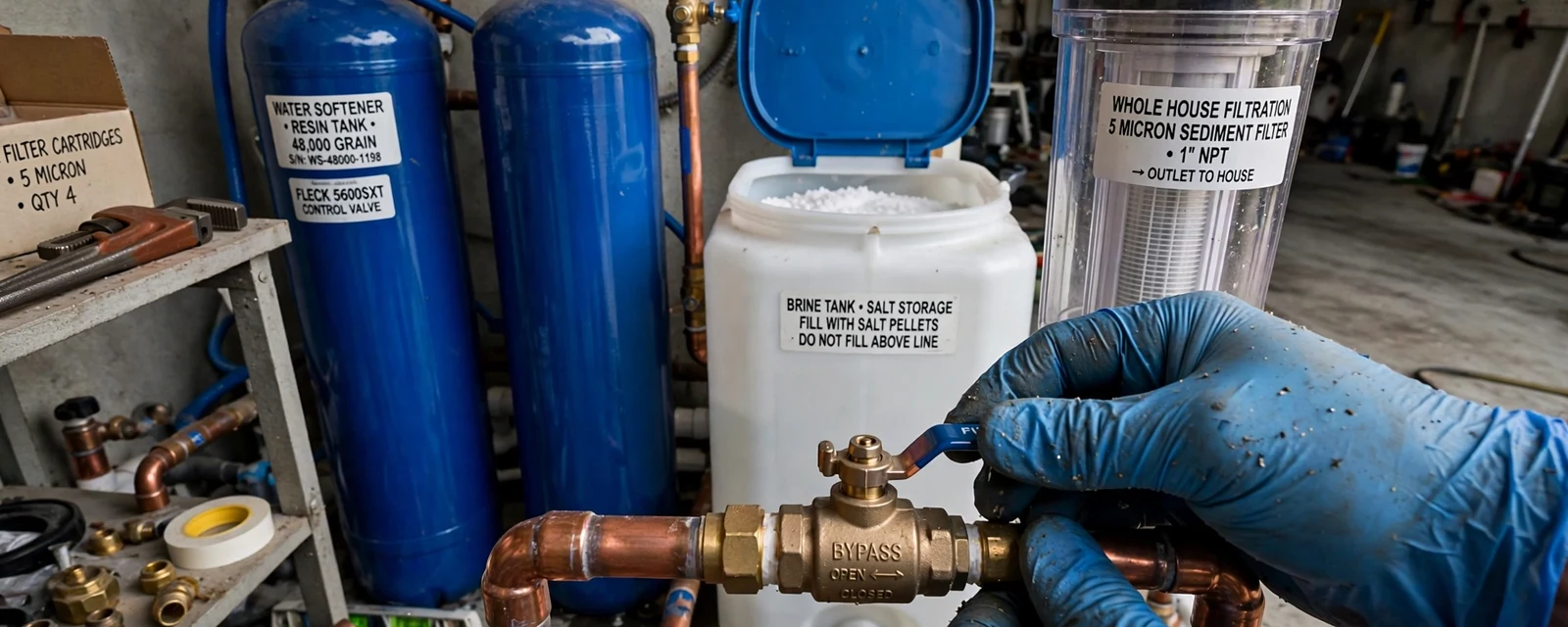
A water softener and filtration system treats the water entering your house so minerals and tastes do not reach the taps. Our licensed plumbers size, install and repair these systems in Winter Springs, FL, and we tell you what each one does and does not do.
Softeners and filters solve different problems, and homeowners often buy one when they need the other. Hardness is scale. Odor, color and chlorine taste are filtration questions. We start by asking what you see in the house, then match equipment to it.
What 150 mg/L hardness does inside your house
The city lists its average as 8 grains. Band names follow the USGS hardness scale and are shown as a general reference.
The city utility lists Winter Springs hardness at an average of 150 mg/L, which it states as 8 grains. On the USGS hardness scale, 121 to 180 mg/L is hard water. Calcium and magnesium come out of solution when water is heated, and they coat heating elements, tank bottoms and the inside of pipes.
That scale shortens water heater life and clogs aerators, according to the city. White crust on faucets and spots on dishes are the visible signs. A softener removes the hardness minerals before the water reaches the heater, which is why most installs go at the point where water enters the house.
Softener or filter: which problem you have
The symptom decides the equipment. This table is how we sort a first call.
| What you notice | Likely cause | Equipment that addresses it |
|---|---|---|
| White crust on faucets, spotted glasses | Hardness minerals | Salt-based softener |
| Soap does not lather well | Hardness minerals | Softener |
| Rotten-egg smell at the tap | Hydrogen sulfide in water | Point-of-entry filter or other treatment, after testing |
| Chlorine taste | Disinfectant residual | Carbon filtration at the tap or house |
| Orange stains on fixtures | Iron, often from shallow groundwater | Iron filter and a test first |
| Cloudy water, grit | Sediment | Sediment pre-filter |
No system removes everything, and we do not promise specific results. A water test tells you what is actually in the water.
How a softener works
The mechanism is simple, which makes repairs predictable.
Resin tank
Water passes through tiny resin beads that hold sodium. Calcium and magnesium swap places with the sodium and stay on the beads.
Regeneration
When the beads are full, the control valve flushes them with brine from the salt tank, then rinses the brine to drain.
Control valve
The valve sets timing and flow. It is the part that fails most often, with symptoms like hard water coming back or water running to drain nonstop.
Bypass
A valve set that lets you route water around the softener during service, so the house keeps running.
Hard water showing up at home
Call (407) 964-8940 and describe the crust, smell or taste you notice.
Sulfur odor, irrigation wells and filters
The city says sulfur odor and orange stains in some homes come from shallow irrigation-well groundwater, not from reclaimed water. The city utility treats its own supply by aeration to remove hydrogen sulfide, then adds liquid chlorine.
The city also notes that point-of-entry filters remove chlorine, which can make natural hydrogen sulfide odor more noticeable. That is a tradeoff worth knowing before you install a whole-house carbon filter. If a smell appears after you add a filter, call us. We check which tap, hot or cold, and whether your water comes from the city or a private well.
Whole-home filtration choices
A whole-home system treats the water at the point where it enters the house, so every faucet, shower and appliance benefits. Typical stages include a sediment cartridge, a carbon block for taste and chlorine, and sometimes a separate unit for iron or sulfur. Each stage has a life and a flow rating.
Pick the system by problem, not by brochure. A softener will not remove chlorine, and a carbon filter will not stop scale. Reverse osmosis at the kitchen sink handles drinking water only, and it wastes some water to drain. If you are replumbing an area anyway, see repiping for how treatment equipment fits into a new layout.
What an installation visit covers
A softener install needs a drain, power, and a place with room for salt.
Find the main entry
We locate the line where water enters the house, ahead of the water heater and any outdoor spigot you want left untreated.
Set the bypass
A three-valve bypass or a built-in one lets you isolate the unit for service.
Connect drain and brine line
The drain needs an air gap so wastewater cannot flow back into the unit.
Program the valve
Hardness, resin volume and household size decide the regeneration setting.
Test and walk you through it
We check for leaks, run a regeneration and show you where the salt goes.
Repairing a softener or conditioner
Most service calls are for the control valve, a salt bridge, or a clogged injector. A salt bridge is a crust that forms in the brine tank and leaves a gap under it, so the unit looks full but makes no brine. Breaking the crust and cleaning the tank often fixes the problem.
If hard water returns, check the salt level and the time on the head first. If the valve runs continuously or leaks at the drain, call us. We also replace worn resin, though a unit older than the resin's life is often cheaper to replace than rebuild. A softener that connects to your water heater line protects the tank from scale, so a failed unit shows up there first.
What affects the cost of treatment equipment
A clear price comes before work starts. These factors drive it.
System type
A basic softener, a multi-stage whole-home filter and an iron filter are different products.
Capacity
Household size, bathrooms and flow demand set the resin and tank size.
Installation layout
Distance to the drain, electrical outlet and access to the main line change labor.
Water test results
If testing finds iron or sulfur, extra stages may be needed.
Ongoing supplies
Salt, cartridges and filter media are recurring costs you should budget for.
A resin tank that cracks and floods the utility room is sudden damage a policy may cover. Scale, a worn control valve or a salt bridge is ordinary wear, and the unit itself is usually not covered. Ask your insurer about your policy.
Tell us the make of any existing unit, or where water enters the house if you have none, and we explain the likely scope before we visit.
Water Softener and Filtration questions answered
The city utility lists average hardness at 150 mg/L, or 8 grains. On the USGS scale, 121 to 180 mg/L counts as hard.
That is enough to leave scale on heating elements and faucet aerators over time.
Not reliably. Hydrogen sulfide is a gas dissolved in water, and softeners are built for hardness minerals. A filter designed for sulfur may help, but we test first and we do not promise results.
The city treats its supply by aeration to remove hydrogen sulfide.
The city notes that point-of-entry filters remove chlorine, and chlorine masks natural sulfur odor. Without it, the smell can be more noticeable.
If you have a private irrigation well, the city says sulfur odor and orange stains come from shallow groundwater.
Check for a stuck valve that keeps regenerating, a salt bridge, or a setting that is too high for your hardness. We test the valve and reset the cycle.
Yes in most cases. We look at the control valve, injector, resin and drain connection. If the unit is beyond practical repair, we say so before replacing it.
Scale hits a tankless unit hard, because the heat exchanger has narrow passages. A softener reduces how often it needs descaling. See tankless water heater for how flushing works.
Yes. We coordinate access with the manager and leave a note on salt type and where the bypass is, so staff can service it.
Yes, including Oviedo, where the city draws water from its own wells. Water chemistry differs by town, so we size equipment to the home.
Questions about your water
Call (407) 964-8940 and tell us what you see, smell or taste at the tap.