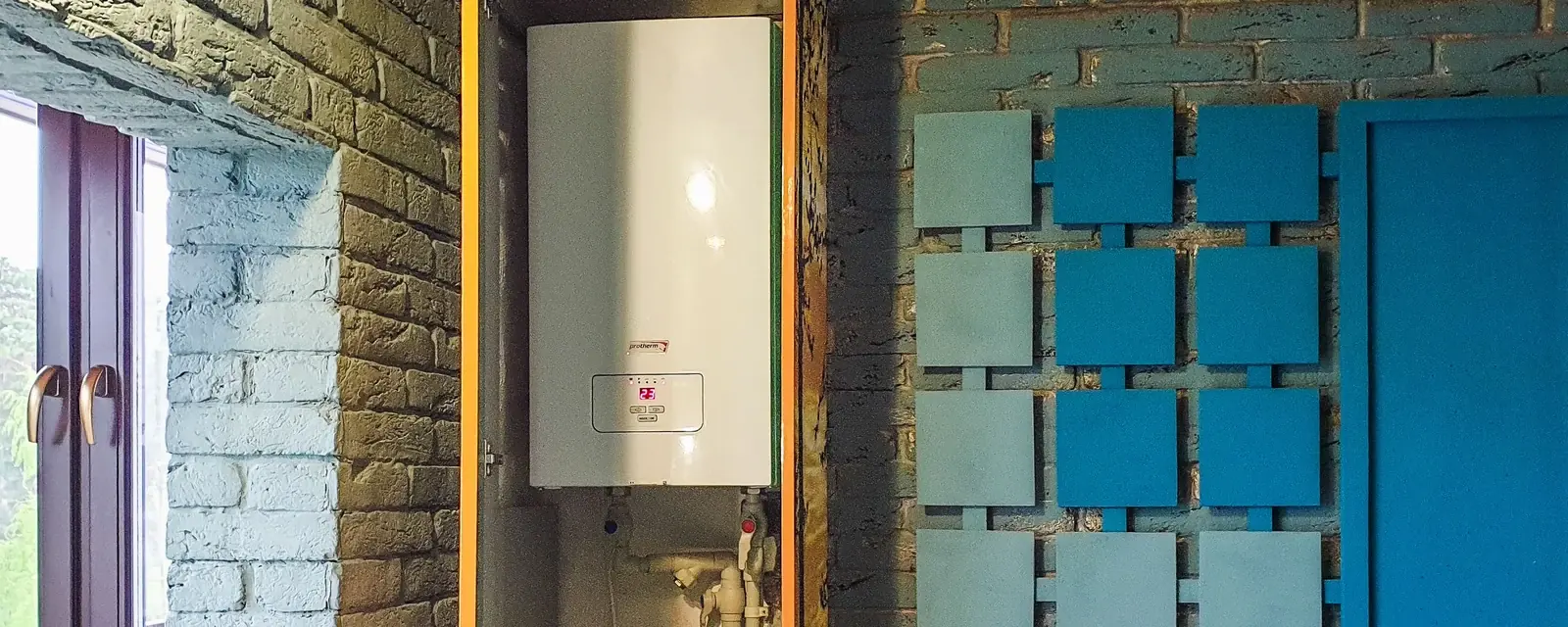
A tankless water heater in Winter Springs, FL heats water only while a tap is open, passing it through a heat exchanger instead of storing it in a tank. That removes the standby loss and the tank that can flood a garage, but it puts more load on the gas line, the vent and the water quality.
We install, repair and descale tankless units, and we size them to the house rather than to the brochure. If you are comparing against a stored-water unit, our water heater installation page covers the tank side of the planning.
Tankless flush and descale: the job that decides lifespan
Inside a tankless unit, water passes through narrow channels around a very hot exchanger. Minerals in the water bake onto those surfaces as scale. A thin layer lowers heat transfer, so the unit works harder, runs hotter and eventually throws an error code or shuts down.
A flush circulates a descaling solution, often white vinegar or a manufacturer-approved product, through the exchanger with a small pump and hoses connected at isolation valves. The unit's manual sets the method and the time. Many units come with those valves, and if yours lacks them we can add them so future flushes are quick.
Do not skip the sediment screen. A clogged inlet filter cuts flow and mimics scale trouble. We clear it, check the gas pressure and the vent, and record what we find so the next visit is faster.
Why Winter Springs water is hard on tankless units
The city lists its average as 8 grains. Band names follow the USGS hardness scale and are shown as a general reference.
The City of Winter Springs lists its water at an average of 150 mg/L hardness, or 8 grains. On the USGS scale, 121 to 180 mg/L is hard. A tankless heater runs hot water through a small exchanger, so that mineral load collects faster than it does in a large tank.
Flush on a schedule that matches how heavily the unit runs, not just the calendar. A water softener upstream reduces the scale that forms, and some manufacturers expect one in hard water. Ask us before you buy a unit so you know what its warranty terms expect.
Tankless versus a storage tank in a typical Winter Springs home
This table frames the decision. Your house, fuel and habits can change the answer.
| Question | Tankless | Storage tank |
|---|---|---|
| Hot water supply | Continuous, but limited by flow rate | Fixed reserve, then it runs out |
| Standby heat loss | None while idle | Constant, small |
| Space | Wall-mounted, compact | Floor-standing, large |
| Leak risk | Small, only on demand | Full tank can empty |
| Maintenance | Regular descaling in hard water | Annual flush and anode check |
| Installation work | Gas line, vent and electrical often upgraded | Usually like-for-like |
Tankless units also need a minimum flow to fire, so very low flows can produce lukewarm water.
Scale or no hot water on a tankless?
Call (407) 964-8940 and tell us the make, the error code and how old the unit is.
Is a tankless water heater right for this house
The honest answer depends on three numbers: how many fixtures run at once, how cold the incoming water is, and how much gas or electric capacity the house can give the unit. A family that showers in a row suits tankless well. A house that runs two showers, a dishwasher and a washer at once may need a larger unit or a second one.
Expect a short delay at the tap. The unit has to detect flow, ignite or energize, and push the water already sitting in the pipe out of the way. A long run from the heater to a far bathroom makes that wait longer, and a recirculation loop or small point-of-use unit can shorten it.
Brief pauses between uses can also give a short burst of cooler water, because the heater shuts off and restarts. Hold the tap open a moment longer before judging the temperature, and tell us if it persists, since a failing sensor can cause the same pattern.
Hybrid heat pump tanks are a separate option, and they are covered on our water heater replacement page. We show both so you can compare.
What an install involves beyond swapping the tank
A tankless unit asks more of the house than a tank does. These are the common upgrades.
Gas line capacity
A tankless gas heater has a high rated input. The existing line may be too small, so we check the unit's rated input against the line before we order.
Venting
Condensing models vent through plastic pipe and drain acidic condensate. Non-condensing models need stainless or approved vent material and run hotter.
Electrical and water
Gas units still need an outlet for the fan and controls. Electric tankless units need heavy circuits that many panels cannot spare.
Isolation valves and a drain
Service valves at the unit let it be flushed without cutting water to the house.
What the city's water means for your warranty and your schedule
Because the city's own figure is 8 grains, a tankless unit here should be treated as a hard-water installation from day one. Keep a record of each flush, because some warranties ask for proof. If you rent the home out, put the flush on the property's yearly maintenance list.
We serve homes near Sanford, about 10 miles away, where the same maintenance habits apply to any gas or electric tankless unit.
What a service visit covers
Whether the unit is new or years old, the checklist is similar.
Read the error history
Most units store codes that point toward flow, ignition or temperature trouble.
Check inlet screen and flow
A clogged screen or partly closed valve cuts flow below the firing minimum.
Flush the heat exchanger
Descaling solution circulates until the flush runs clear, then the unit is rinsed.
Test combustion and venting
On gas units we check flame, gas pressure and vent condition.
Confirm temperature at the tap
We measure the outlet temperature and explain the setting.
What affects the price of tankless work
Tankless jobs vary more than tank swaps. These are the factors.
Unit size and fuel
A gas model for a large household costs more than a small point-of-use electric unit.
Gas line and vent upgrades
A larger gas line or a new vent run adds materials and labor beyond the heater itself.
Water treatment
A softener or scale inhibitor adds cost but reduces the descaling burden.
Condition of existing plumbing
Corroded valves or unions get replaced during the install.
Flush or repair scope
A flush with existing isolation valves is quick. Adding valves or replacing parts extends the visit.
A supply line that bursts and floods the utility room is a sudden accident a policy may cover. Scale on the exchanger is gradual, so it is treated as maintenance, and the failed unit itself is usually not covered. Ask your insurer.
A flush on a unit that already has isolation valves is the simplest visit. Ask which category yours falls in, and you hear the price before work starts.
Tankless Water Heater questions answered
Follow the manufacturer's interval, and shorten it for hard water. The city lists 8 grains of hardness, so heavy use or no softener argues for flushing more often. A clue that it is due is a drop in flow, a rumbling sound or an error code.
Some owners do, using a small pump, hoses and the unit's isolation valves. Close gas and power first and follow the manual. Call us if the valves are stuck, the unit has no service valves or you smell gas.
It does not run out in the way a tank does, but it has a flow limit. If you open more taps than the unit can heat, temperature drops. That is a sizing question, and we check it before installing.
No. A hybrid is a storage tank with a heat pump on top. It saves energy but still holds water. Tankless heats on demand with no tank, so the two solve different problems.
Common causes are scale on the exchanger, a clogged inlet screen or flow below the firing minimum. A mixing cross-connection between hot and cold lines can also do it. We test flow and outlet temperature to find which one.
Yes. Give us the property address, unit make and tenant contact. We tell you the flush date so your management team can keep it for warranty claims.
It can if the manual requires treatment and none is installed. Read the warranty terms, or give us the model number on the call, and we will tell you what it expects.
Our 24/7 dispatch takes calls at any hour. We will walk you through what to shut off, and if a part is needed, we will explain the next step.
Not sure about tankless?
Tell us how many baths and appliances run together and we will say whether one unit covers it.