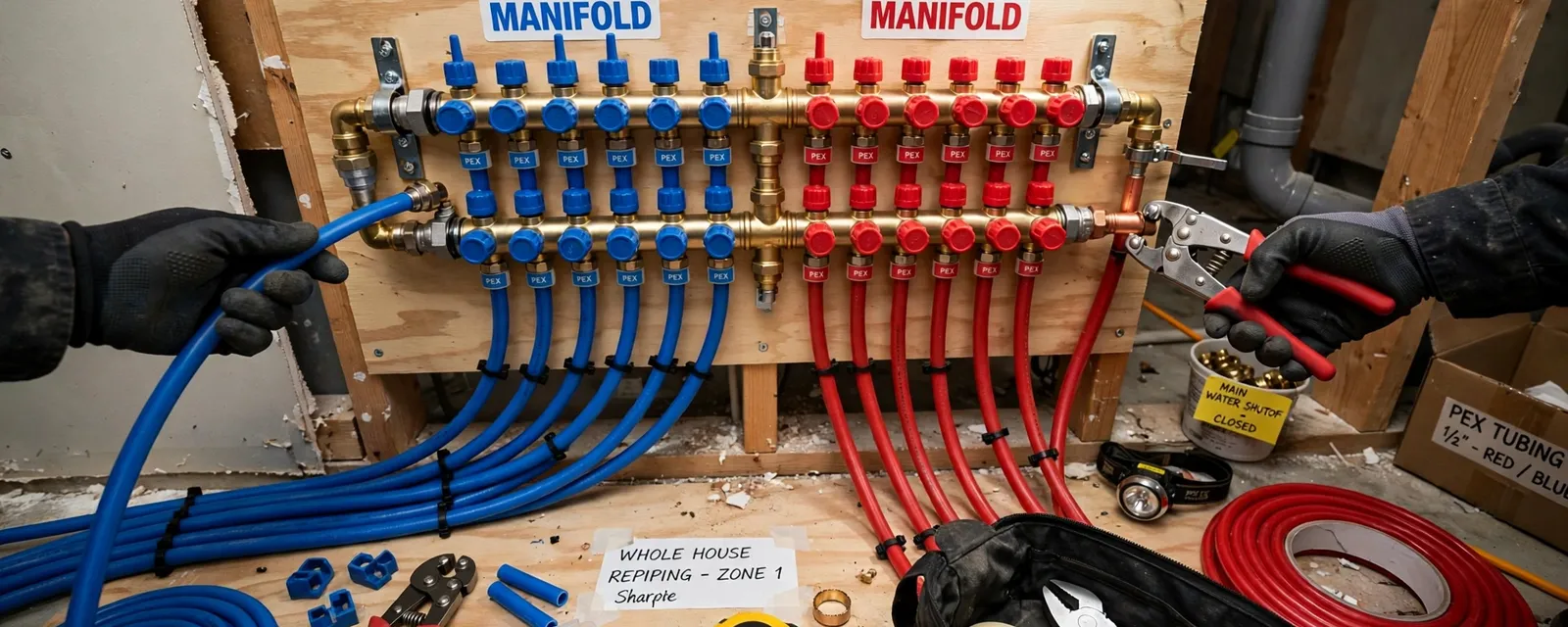
Repiping in Winter Springs, FL means replacing the water supply pipes inside a house, either the whole system or a major section, with new PEX or copper. It is a planned job, usually done when old pipe keeps leaking or no longer delivers clean, steady water.
This page explains the warning signs, how we decide between a patch and a full repipe, and what to expect in your home during the work.
Rusty water, low pressure and repeat leaks: when old pipe is done
One leak does not mean a house needs new pipe. A pattern does.
Brown or orange water
Rust flakes inside galvanized steel pipe color the water, especially after it sits overnight.
Low pressure at several fixtures
Mineral and rust buildup narrows the inside of the pipe until flow drops.
Pinhole leaks that keep coming
Repairing one pinhole in copper often precedes another, because the pipe wall is thin along its length.
Stains on ceilings and walls
Slow leaks inside walls leave spreading stains, and the damp framing can grow mold.
Metallic taste or odor
Corroded pipe can affect taste. If you are worried about water quality, a lab test answers it, and we do not give medical advice.
PEX or copper: which pipe goes in
Most repipes today use PEX or copper. Both work well when installed correctly, and the choice comes down to the house and your priorities.
| Factor | PEX | Copper |
|---|---|---|
| How it installs | Flexible tubing, fewer fittings, fished through walls | Rigid pipe, soldered or pressed joints, more cuts |
| Wall damage | Usually less, since it bends around framing | Often more openings to reach joints |
| Heat and sunlight | Must be protected from UV and not run near flue pipes | Handles heat and sun well |
| Lifespan outlook | Newer material, long track record in homes | Decades of use, can pit in aggressive water |
| Water noise | Quiet, resists some water hammer | Can transmit knocking if not secured |
| Cost trend | Generally lower material and labor | Generally higher |
Ask us which fits your house. We use approved fittings and follow the Florida Building Code, Plumbing.
What year was your home built?
Winter Springs was incorporated in 1959 as the City of North Orlando and took its present name in 1972. Homes from the 1970s onward are common here, including the Tuscawilla area built around the 1971 country club.
Pipe materials change with construction era, and some owners have already replaced parts of the original lines. So we do not guess. Ask what year your home was built, tell us what you have seen, and we inspect exposed lines and test pressure to judge what is still serving you.
Wondering if your pipes need replacing?
Call (407) 964-8940 and describe what you see. We will tell you what to check.
Galvanized pipe, CPVC and the case for replacing
Galvanized steel pipe has a zinc coating that wears off. Rust forms inside, slowly narrowing the passage and giving the water an orange tint. Replacing it is usually a matter of when, not whether.
CPVC is the cream-colored plastic pipe used in many homes from later decades. It can turn brittle with age and heat, and fittings are often where it cracks. A single crack does not mean the whole house needs replacing, but several do.
We look at the pipe you actually have, test it and tell you plainly whether repair or replacement is the better call.
Hard water and your pipes
The city lists its average as 8 grains. Band names follow the USGS hardness scale and are shown as a general reference.
The City of Winter Springs reports that its water averages 150 mg/L hardness, which it lists as 8 grains. On the USGS scale, 121 to 180 mg/L counts as hard.
Hardness scale builds on heating elements and clogs aerators, and it can also line pipe walls over the years. That is general mineral behavior, not a claim about your pipes. If you plan a repipe, a water softener is worth discussing alongside it.
How a whole-house repipe is done
A repipe disrupts the house for a short time, but it follows a clear order.
Walk-through and plan
We trace the current layout, mark fixtures and choose pipe routes through the attic, walls and floor.
Shut off and drain
We close the main, drain the system and set up so you can still have water at points where possible.
Open access points
We cut small openings to fish the new pipe, instead of removing whole walls.
Run and connect new lines
New supply lines connect to every fixture, the water heater and the main.
Pressure test and patch
We test every connection at full pressure before closing openings. Wall patching is arranged separately.
Repiping, slab leaks and spot repairs
Sometimes repiping is the answer to a leak under the floor. If the lines that run beneath the concrete have failed more than once, rerouting new pipe through the attic or walls avoids breaking the slab each time. Read about that decision on our slab leak repair page.
If your problem is a single burst or one clear break, we will repair it rather than recommend a full job. Burst pipe repair is the faster fix when the rest of the pipe is sound.
Getting the house ready for a repipe
A little preparation keeps the work quick and your belongings clean.
- Clear the areas under sinks and around the water heater.
- Move furniture away from walls where we will open access.
- Empty closets that sit on a pipe route.
- Plan for the water to be off for part of the day.
- Secure pets away from open walls and tools.
- Take photos of walls and ceilings before work begins.
Mixing old and new pipe
A partial repipe connects new pipe to old, and that joint is where problems start if dissimilar metals touch. We use dielectric fittings or transition couplings to avoid galvanic corrosion where copper meets steel.
Partial work makes sense when only one branch is bad, like a bathroom group or a single run to the kitchen. The weak point is that other old lines can still fail later. We tell you that trade-off before you choose.
What drives repiping cost
We give a clear price before work starts. A repipe is not a flat-rate job, because these factors vary from house to house.
Size of the house and fixture count
More bathrooms and fixtures mean more pipe and more connections.
Pipe material
PEX and copper differ in material cost and labor.
Access
An open attic is easier than a finished two-story home with tile and cabinets in the way.
Whole house or partial
Replacing one section costs less than all supply lines.
Patching and finishing
Drywall repair, paint and flooring are separate work after the plumbing is done.
If an old pipe bursts and ruins a floor, insurance typically looks at that sudden accidental damage. Replacing pipe because it is old, worn or corroded is a planned upgrade, not an accident. Ask your insurer before you decide.
Permit rules vary, so ask the Winter Springs building department about requirements for your project.
Repiping questions answered
Count the leaks, look at the water and test the pressure. One leak with otherwise sound pipe is a repair. Repeated pinholes, brown water and weak flow at many fixtures point toward replacement.
It depends on the size of the house and the access to the pipe. We can give a realistic schedule after seeing the home, and we plan work so the water is off for the shortest time practical.
Usually yes, but water is shut off during parts of the work. Some families stay elsewhere for the day. We tell you in advance which hours are without water so you can plan.
Both PEX and copper are used in hard water areas. Hardness matters more for your water heater and fixtures than for the choice of pipe. We can discuss a softener if scale is a concern.
No. Pipe age varies by subdivision, and many homes from the 1970s onward have had work done. Ask what year your home was built, then have the lines checked rather than assuming.
Permit rules vary, so ask the Winter Springs building department. We can explain what the work involves so you have the details ready when you ask.
Yes. Property managers can give us the unit address, tenant contact and the access window when they call. We coordinate scheduling with the tenant.
We have 24/7 dispatch. Active leaks are treated as urgent, and the larger repipe is planned afterward. We also serve Oviedo and nearby towns.
Ready to plan your repipe?
Call (407) 964-8940 and we will talk through what your house needs.