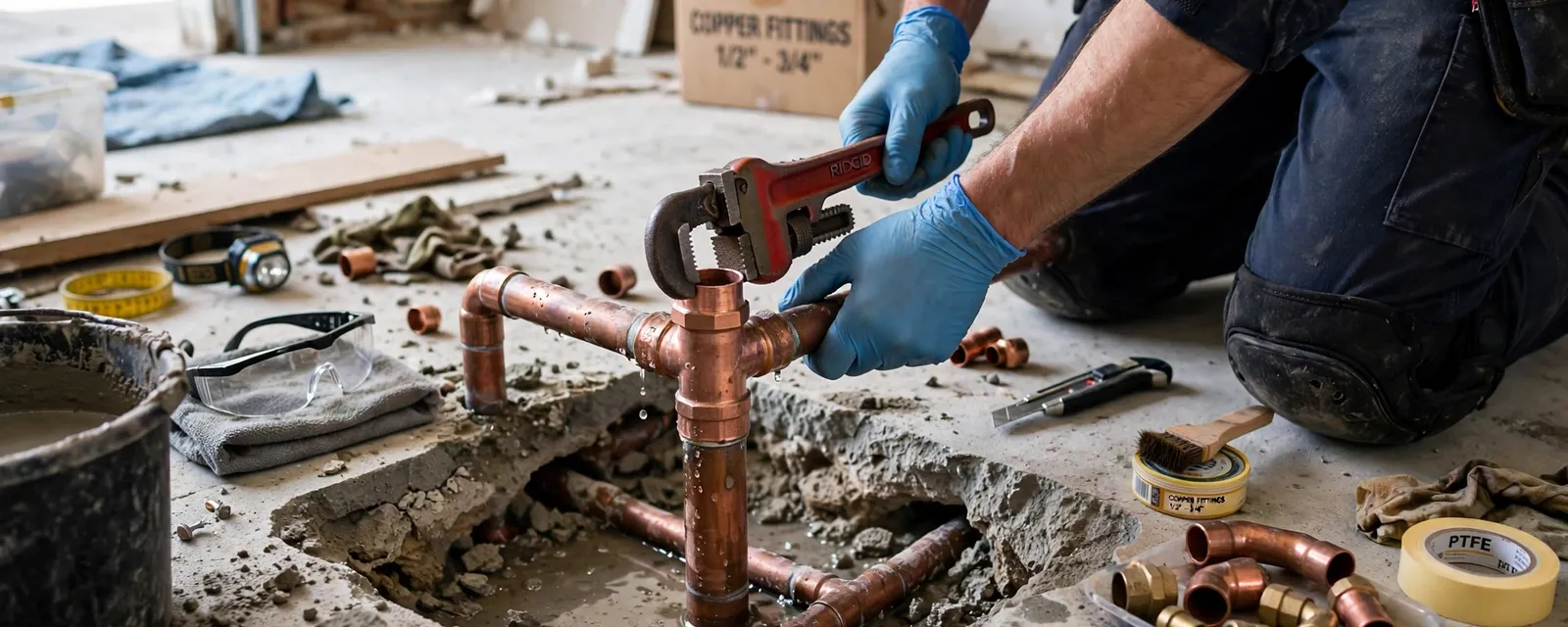
A slab leak is a leak in a water line that runs in or under the concrete foundation of a house, and slab leak repair in Winter Springs, FL starts with proving that is where the water is going. If water is rising through flooring, call our 24/7 dispatch right away.
Until we arrive, shut off the main valve and turn off the water heater's gas supply so it does not fire on an empty tank. For an electric heater, cut power at the breaker only if the panel is dry and reachable without standing in water. Otherwise call. Open a faucet to relieve pressure and keep family and pets off any wet floor.
Warm floors, a constant hiss and other signs the slab is leaking
Concrete hides a leak, but the home usually gives it away. These are the symptoms we hear about most.
A warm or hot spot on the floor
A leaking hot water line heats the concrete above it. The spot stays warm even when no hot water is running.
Running water sound with everything off
A faint hiss or trickle from the floor in a quiet house points to pressurized water escaping.
A meter that keeps moving
With every fixture off, a spinning meter means a leak somewhere between the street and your faucets.
Damp carpet, lifting tile or cracked grout
Water pushing up through the slab loosens flooring and leaves damp patches along baseboards.
Low hot water pressure
Pressure drop on the hot side only often means the hot line is the leaking one.
How we pinpoint the leak before any concrete is cut
Breaking a slab at the wrong spot costs time and money, so locating comes first.
Isolate the system
We shut off the water heater and close branch valves to see which line is losing pressure.
Pressure test the lines
A gauge on each isolated line shows whether it holds. A line that drops is the leaking one.
Listen along the floor
Acoustic sensors pick up the hiss through the concrete. The loudest point marks the likely break.
Confirm with a second reading
Thermal imaging or a moisture meter backs up the sound before we cut anything.
Spot repair, reroute or repipe
There are three ways to deal with a slab leak. Which one fits depends on the pipe, the number of leaks and how much of the house you want to disturb.
| Option | What it involves | Best when | Trade-off |
|---|---|---|---|
| Spot repair | Break the slab at the leak, replace the damaged section | One clear leak in otherwise sound pipe | More leaks may follow in old pipe |
| Reroute | Abandon the slab line and run new pipe through walls or the attic | Leaks keep recurring or the slab is hard to open | Some wall or ceiling patching |
| Repipe | Replace most or all supply lines in the house | Many leaks or pipe at the end of its life | Biggest job, longest disruption |
We explain which option fits and what each would involve before any concrete is touched.
Floor warm and the meter spinning?
Call (407) 964-8940 and we will arrange a slab leak test.
Why rerouting is often the better call
Cutting a slab is noisy, dusty and messy. A reroute avoids it by capping the leaking line at both ends and running new pipe overhead or through walls to the same fixtures. The slab stays intact and the old pipe is simply abandoned.
The new route is usually PEX or copper, chosen for the house. Because it travels through accessible space, any future problem can be fixed without breaking concrete again. That is a real advantage in a home where the old lines have already failed once.
The cost of a reroute is patching drywall or a ceiling where the pipe passes. Where the layout makes that impractical, spot repair is the better fit. Our repiping page explains the larger version of this job.
When a slab leak needs a plumber tonight
Call now if water is surfacing through flooring, the meter is moving fast, or the house smells musty and the floors are warm. Water that pools under flooring can spread into walls and neighboring rooms, so waiting makes the damage bigger.
A slow slab leak that you only notice on the bill can usually wait for a same-day appointment when available. Either way, shut the main at night if no one is using water.
Water heater leaks near the slab edge
Not every wet floor is a pipe in the concrete. A water heater in a garage or closet can leak from a tank seam, a relief valve line or a fitting, and the water travels across the slab edge to a spot that looks like a slab leak.
We check the heater and its connections first when the wet area sits near it. If the tank itself is leaking, it needs replacing, and our water heater replacement crew handles that. If the heater is dry, the leak is in the pipes.
Pipe age in homes from the 1970s onward
Winter Springs became a city in 1959 as North Orlando and took its present name in 1972. Homes from the 1970s onward are common here, including the Tuscawilla development built around the 1971 country club.
Pipe age varies by subdivision and by whether the original lines were ever replaced, so ask what year your home was built. In an older house, a first slab leak can be a sign of other weak lines. That is why we test all lines before choosing spot repair over a reroute.
What a camera and sensors cannot do
A camera cannot see inside a slab, and acoustic gear works less well on plastic pipe or when water noise from a neighbor's line interferes. Sometimes the readings leave a small area of doubt rather than an exact point.
When that happens we say so and narrow it with more tests instead of cutting on a guess. If we cannot confirm a slab leak, leak detection in other parts of the house may find the real source.
What to do after the water is off
Stopping the water is only the first step. These actions protect the house and make the repair visit faster.
- Take photos of wet flooring, walls and any stains.
- Move furniture and rugs off the damp area.
- Run a fan or dehumidifier to slow mold.
- Note the meter reading and the time you shut the main.
- Write down which fixtures run hot and which do not.
- Keep the water heater off until we check it.
What drives slab leak repair cost
We give a clear price before work starts. These factors move it up or down.
Repair option
A spot repair is a smaller job than a reroute, which is smaller than a full repipe.
Depth and flooring
Tile, hardwood or thick concrete over the pipe takes longer to open and restore.
Pipe material and length
More footage of new pipe and fittings adds to the job.
Number of leaks
Several breaks in one line often point toward a reroute.
Restoration needed
Patching concrete, flooring and drywall after the repair is a separate scope.
Wet flooring and drywall from a leak that appears suddenly are what insurance typically considers. Breaking the slab to reach the pipe, and the pipe that corroded, are often treated as a separate matter. Ask your insurer how your policy treats slab leaks before you start.
If you plan to file a claim, save your own photos and the meter readings you noted.
Slab Leak Repair questions answered
Yes. Our dispatch runs 24/7. If water is coming through the floor, shut off the main valve and call. We will advise you on the water heater and give you an appointment time. Slower leaks are booked as same-day appointments when available.
A warm floor spot, sound from the floor and a meter that moves with everything off are the strongest clues. We confirm with isolation, pressure and listening tests. A single symptom is not proof.
Sometimes, by rerouting the line through walls or the attic so the slab stays intact. Spot repair requires opening the concrete at the leak. We explain which is practical for your house.
Long-term leaks can wash soil from under the slab and soften the ground. That can be a concern for cracking. We are plumbers, not structural engineers, so if you see cracks in walls or floors, ask a structural professional as well.
It changes where we look. Hot lines warm the concrete, and the heater often runs more as it refills. Hot lines also corrode in some homes, so we pressure test them closely.
It depends on the option. A spot repair is usually shorter than a reroute, and a repipe takes longest. We can give you a realistic window once we know the scope, but we do not promise a time before testing.
Yes. Give us the unit address, the tenant's contact and a description of the symptom. We will coordinate entry and talk through the findings with the owner.
Yes. We cover Casselberry and other nearby towns from Winter Springs, and our dispatch runs around the clock.
Think there is water under your floor?
Call (407) 964-8940 and describe what you see, hear and feel.