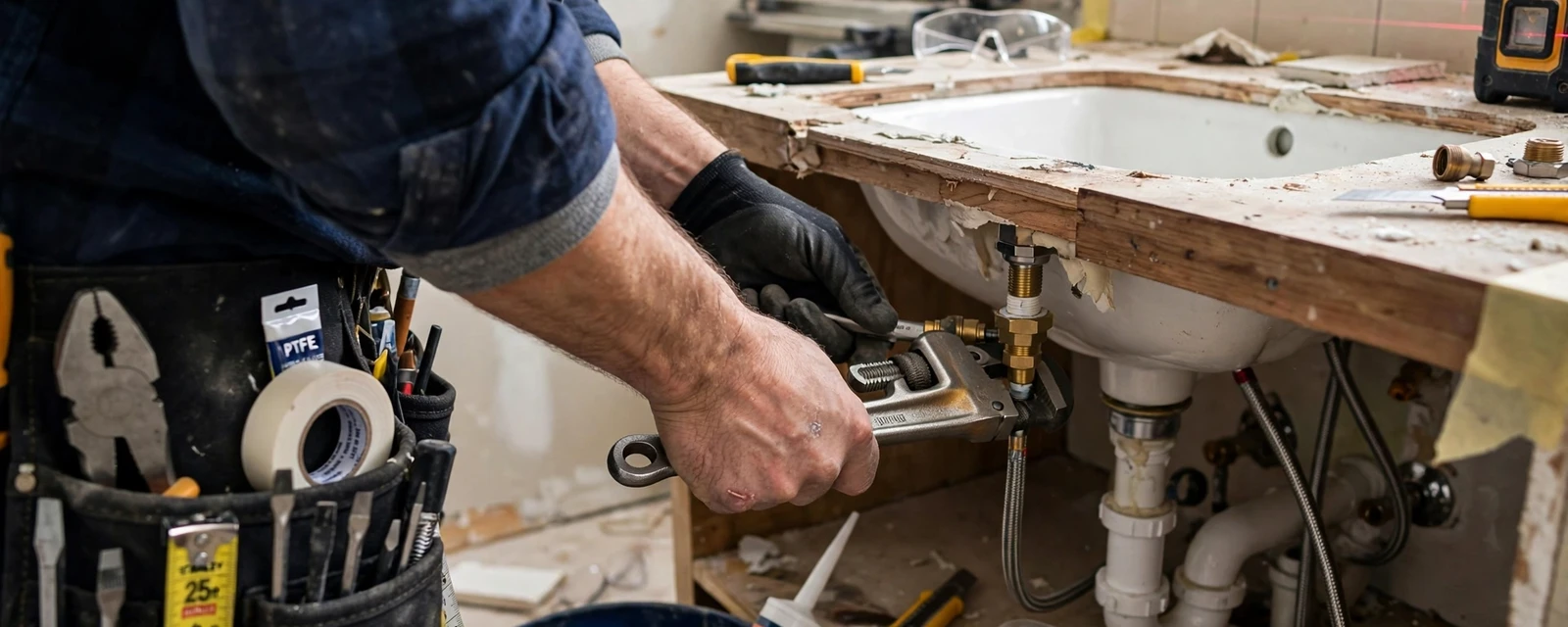
Plumbing installation in Winter Springs, FL means putting in new fixtures, supply lines, drains, pumps and gas piping so they work, pass inspection where required, and do not leak behind a wall. Our licensed plumbers install the work, test it under pressure, and explain what we found.
Installation jobs are won or lost in the planning. Pipe size, slope, venting and shutoff placement are set before any fixture arrives, and the permit question is raised on day one rather than after the drywall goes up.
Smell gas? Leave first, then call
If you smell gas, hear a hiss near a gas line, or a carbon monoxide alarm sounds, leave the building at once. Do not switch lights on or off, use a phone inside, or start a car in the garage. Call 911 or your gas utility from outside, before you call a plumber.
A plumber can inspect and repair gas piping after the utility has made the area safe, but we do not promise a gas response time, and a gas leak is never a job to wait out. Once it is safe, we can pressure-test the line, find the failed fitting and replace it.
Gas line inspection and new gas piping
Adding a gas dryer, range, outdoor grill line or tankless water heater means running new gas pipe from an existing branch. The pipe has to be sized for the total demand of the appliances on that branch and the length of the run, and the appliance rating plate shows the input it needs.
Before connecting, we pressure-test the new section with air and check every joint with a leak-detecting solution. Permit rules vary, so ask the Winter Springs building department about what your job needs. We can tell you what documents the city form asks for, including the number of plumbing fixtures and a licensed contractor and qualifier.
Common installations and what each involves
Each install has its own prep. This is how we scope the typical ones.
| Installation | What we check first | Typical complication |
|---|---|---|
| Toilet or sink | Rough-in distance, shutoff valves | Old valves that will not close |
| Bathtub or shower | Drain location, subfloor strength, valve depth | Wall framing in the way |
| Outdoor faucet | Where the line comes off the wall | Freeze-style vs standard bibb, drain slope |
| Sump or ejector pump | Basin depth, check valve, discharge route | Power supply and where water goes |
| Gas appliance line | Appliance input and run length | Existing pipe too small |
| Backflow assembly | Type required, location, test cocks | Clearance and testing access |
Each of these jobs also needs access to be confirmed before we price it.
Planning a plumbing install
Call (407) 964-8940 to talk through scope and permits before you buy fixtures.
How an installation job runs
Our order of work is the same whether it is a single fixture or a bathroom addition.
Walk the site
We look at where lines and drains already run and where the new fixture needs to land.
Raise permit questions
The city application says a separate permit must be secured for plumbing. Permit rules vary, so ask the Winter Springs building department about your job.
Locate underground lines
For anything that digs, someone must call 811 at least two full business days before work starts.
Rough in and test
Pipes are installed and pressure-tested before walls close.
Set fixtures and finish
Fixtures go on, seals are checked and the system runs for leaks.
Backflow testing and assemblies
A backflow device keeps water from moving backward into the drinking supply. The city cross-connection control manual, Ordinance No. 493, adopted July 23, 1990, requires devices with test cocks to be tested once a year. Only certified device testers are accepted by the city utility department.
Lawn sprinkler systems must have an AVB, PVB or DCVA, and a DCVA is used on fire sprinkler lines. Hospitals need an RP device on main service connections. The customer pays for testing and repairs, and results go to the city Utility Department.
We can install a new assembly or replace a failed one, and a certified tester must perform the annual test. Ask the city utility which test form it wants. See commercial plumbing if the device sits on a business property.
New construction and remodel rough-ins
Rough-in is the plumbing that goes in before walls and slab are finished. On new construction it covers underground drains, supply lines and fixture stub-outs. The city permit form asks for the number of plumbing fixtures, which relates to Florida Building Code, Plumbing, Sec. 403.
On a remodel, the harder question is what already exists. Old drains may need venting changes, and a bathroom moved across the house means new waste lines and a new vent path. We assess it before pricing.
Before you dig in Winter Springs
Florida law, Chapter 556, asks anyone digging to call 811 at least two full business days before starting. Online tickets can be filed any hour at sunshine811.com. Utility lines run under driveways, lawns and sidewalks, and hitting one with an excavator or a trencher turns a plumbing job into an outage.
The city building department sits at 1126 East State Road 434, and its application asks for plumbing fixture counts and a contractor license number. If your project is a water heater or a pump swap, permit rules vary, so ask the Winter Springs building department before work starts.
What shapes the cost of an installation
We give a clear price before work starts. A new fixture is a different job from a new line, and these are the main factors.
Scope of the rough-in
Replacing a toilet in the same spot is simple. Moving it means new waste and vent lines.
Materials
Pipe type, fixture grade and valve quality all change the total.
Access
Slab, finished walls and tight crawl spaces add labor.
Permits and inspections
Where a permit is required, the process adds time and fees set by the city.
Testing and certification
Backflow assemblies and gas lines require tests before they can be used.
A planned installation is not an insured loss, so the new fixture or line is your cost. If a fitting fails later and floods a room, that sudden damage may be covered, though the failed part itself usually is not. Ask your insurer.
Have the plans or the fixture model number ready when you call and we can scope the work faster.
Plumbing Installation questions answered
The city building permit application says a separate permit must be secured for electrical work, plumbing and signs. Whether your specific job needs one depends on its scope, and permit rules vary, so ask the Winter Springs building department.
We can tell you what our part of the job involves so you can ask the right question.
Leave the building and call 911 or your gas utility from outside. Do not use switches or phones inside. A plumber is not the first call for a gas smell.
Once the area is safe, call us for line inspection and repair.
The city's cross-connection control manual requires devices with test cocks to be tested once a year, and only certified testers are accepted.
Results go to the city Utility Department, and the customer pays for testing and repair.
Yes. The basin must be sealed where required, the check valve set in the right direction, and the discharge routed away from the foundation. Pumps need a power source, which may mean an electrician.
If digging is involved, a ticket must be requested at least two full business days beforehand. Online tickets are available 24/7.
We explain whether your job breaks ground when we scope it.
Yes. We confirm the model information, rough-in distance and valve compatibility first, because a wrong fit is easier to catch before the old fixture comes out.
Our 24/7 dispatch takes calls at any hour. Installation work is usually scheduled, though same-day appointments are offered when available. Urgent failures are handled by the repair pages such as water heater repair.
Yes, including Lake Mary and other Seminole County communities. Call with the address and the job.
Ready to scope your install
Call (407) 964-8940 and describe the fixture, line or pump you want.