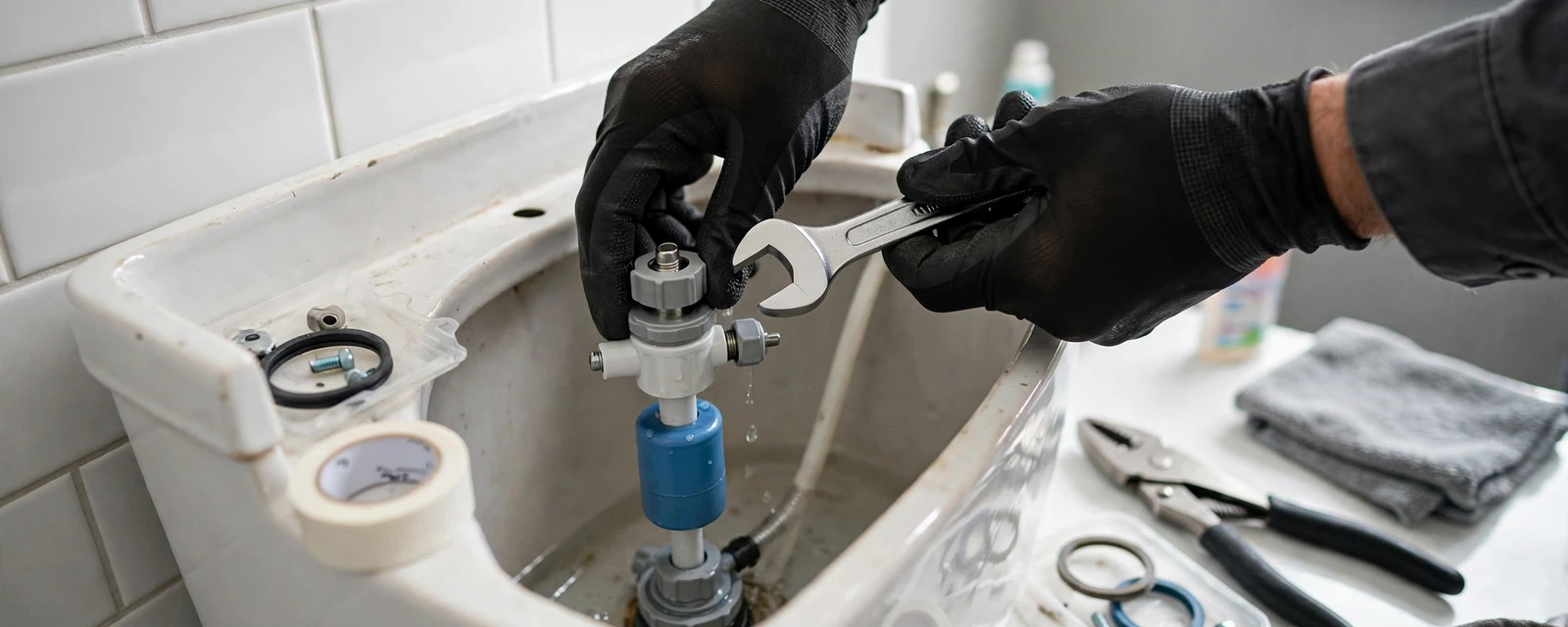
A toilet flange repair ring is a metal or plastic plate that screws down over a cracked or broken flange and gives the toilet bolts a solid place to anchor. It works when the drain pipe below is sound and the floor under the flange is firm. Pair it with a new wax ring, set the toilet, and check for a rock-solid seat.
If the floor is soft, the pipe is cracked, or the flange sits far below the floor, stop and call a plumber.
The flange is the ring on the floor where the toilet meets the drain. It holds the closet bolts, and it sets the height of the wax ring seal. When the flange cracks, the toilet rocks, the wax breaks, and water or sewer gas escapes at the base.
You can often see the trouble before you lift the toilet. A toilet that shifts when you sit, a damp spot at the base, a faint sewer smell, or a floor that has gone soft are all signs. Fixing a flange is within reach for a careful DIYer, but the prep work decides if the repair lasts. A cracked flange on a rotted floor needs toilet repair from a licensed plumber.
Which flange problem do you have?
Not every flange failure needs the same fix. Pull the toilet and match what you see to this table.
| What you find | What it means | Usual fix |
|---|---|---|
| Cracked plastic or cast iron ring, floor solid | Flange broke around the bolt slots | Repair ring over the old flange |
| Flange sits below the finished floor | Tile or flooring was added after install | Extender ring or spacer, plus a thicker seal |
| Rusted bolts spinning in the slots | Bolts lost their grip | Repair ring with new bolt slots, or new bolts |
| Soft or dark subfloor around the flange | Slow leak rotted the wood | Call a plumber, floor repair comes first |
| Cracked pipe or loose flange glued into the pipe | Drain pipe damage below the floor | Call a plumber |
A repair ring cannot fix a pipe problem or a rotten floor. It only fixes the ring itself.
Why flanges fail in the first place
Plastic flanges crack when a toilet is overtightened or when the floor shifts under it. Cast iron flanges rust, then flake. Brass and stainless flanges last longer but still lose their grip if the screws loosen in the subfloor.
Another cause is a toilet that was never fully secured. A rocking toilet works the wax ring loose, which lets water seep out. That water finds the flange and floor first, and over months it softens the wood around the screws.
Ask what year your home was built. You will know once the toilet is up.
Signs the flange is the problem, not just the wax
A bad wax ring and a bad flange can look alike. These clues help you tell them apart before you buy parts.
- The toilet rocks even after the nuts are tight
- The closet bolts spin or tilt in their slots
- Water appears at the base only after a flush
- The floor around the base feels spongy
- The flange is visibly cracked or bent when the toilet is up
- The base has shifted from its original outline on the floor
Toilet rocking or leaking at the base?
Licensed plumbers can reset the toilet, replace the flange, and repair the floor under it. Call (407) 964-8940 any hour. The line is open 24/7.
Wax ring or wax-free seal: what actually matters
The seal between the toilet horn and the flange has to be gas-tight and water-tight. A standard wax ring does this by compressing into the gap. A wax-free rubber seal does the same with a molded gasket.
The ring does not hold the toilet in place. The closet bolts and the flange do. If the flange is broken, even a perfect new wax ring will fail again within weeks, because the toilet shifts and tears the seal.
Choosing a repair ring
Stainless steel rings are strong and resist rust. They suit cast iron and plastic flanges alike. Plastic rings are cheaper and fine on a firm floor but can flex under load.
Look for rings that have a rim to bridge a broken flange edge and slots that line up with the toilet bolts. Measure the inside diameter of your drain pipe. Most home toilets use a standard 3 or 4 inch outlet, so check the package before buying.
Installing a repair ring
This works for most standard toilets. Work slowly, and wear gloves.
Shut off and drain the toilet
Close the supply valve, flush, and hold the handle down. Sponge out the leftover water. Disconnect the supply line from the tank.
Lift the toilet and cover the drain
Remove the closet bolt caps and nuts. Rock the toilet gently and lift it straight up. Stuff a rag in the drain to block sewer gas and keep tools out.
Scrape and inspect
Remove all old wax with a putty knife. Look at the flange and the floor. Push on the wood around it. If your screwdriver sinks in, stop here.
Fit the repair ring
Set the ring over the old flange, line up the bolt slots with the toilet footprint, and drill pilot holes if needed. Use corrosion-proof screws long enough to bite into solid subfloor, not just through tile.
Set the new seal and toilet
Install new closet bolts in the ring slots. Place the wax ring on the horn or flange, lower the toilet straight down, and press firmly. Do not twist it after contact.
Tighten and test
Snug the nuts a little at a time, alternating sides, until the toilet no longer rocks. Do not overtighten, since porcelain cracks. Reconnect the supply, flush several times, and look for water at the base.
A flange that sits too low
If the flange is below the finished floor, a standard wax ring will not seal. A thicker wax ring with a plastic horn can bridge a small gap, but a large gap needs an extender ring or spacer. Stacking two wax rings is a common shortcut that often fails, because the seal cannot compress evenly.
Winter Springs sewer system and a toilet that backs up
The city of Winter Springs reports 112 miles of gravity sewer mains, 24 miles of force mains, and 43 lift stations. Most home toilets drain into a gravity line that runs to one of those mains.
If more than one fixture backs up at once, the problem is probably in your main line or the city side, not the flange. In that case, ask the city Utility Division where city responsibility ends before you pay for a repair at the toilet.
Source type: city utility division page, winterspringsfl.org
When to stop and call a plumber
Call if the subfloor is soft, black, or crumbles under a screwdriver. A leaking flange can rot the wood for years, and a repair ring screwed into rotten wood will not hold.
Call if the drain pipe is cracked, if the flange is cast iron and badly corroded, or if the flange is attached to the pipe in a way you can not see. Call if the toilet is on a second floor and water has already stained the ceiling below.
Also call if you smell sewer gas after the toilet is set. A properly seated toilet should smell like nothing. A lingering smell means the seal is open somewhere, or the problem is deeper in the line, and a sewer camera inspection may be needed.
What a plumber does that you probably will not
A plumber checks the drain pipe below the flange for cracks and slope, cuts out a damaged flange, and glues a new one onto the pipe at the right height. They also repair the subfloor so the new flange sits on firm wood or concrete.
That step is the difference between a quick fix and a lasting one. A repair ring sits on top of the old problem. Replacing the flange removes it. Ask for a clear price before work starts, and ask what the floor repair adds. Setting a new flange is also part of any plumbing installation that moves or replaces a toilet.
Questions readers ask
Yes, if the pipe is sound and the cast iron is solid. Use screws made for the material, and drill pilot holes. If the cast iron crumbles or is badly rusted, replacement is better.
Snug is enough. Tighten each nut a little at a time, alternating sides, until the toilet stops rocking. Overtightening cracks the porcelain base.
Yes. Wax holds its shape after compression and will not seal a second time. Replace it any time the toilet is lifted, even for a quick look.
It points to the main line, not the flange. Stop using water and call. The city lists 112 miles of gravity sewer mains, and where city responsibility ends is a question for the Utility Division.